Life Beyond the Checklist: Revitalizing the potential of Environmental Impact Assessments through co-creation
Our article “Life Beyond the Checklist” introduces a fresh perspective on environmental impact assessments (EIAs), arguing that moving beyond rigid procedural checklists can unlock deeper value for addressing social and ecological consequences of development -both benefits and potential burdens.
Published in Environmental Impact Assessment Review (Impact Factor, 11.2), the article highlights limitations of traditional checklist-based approaches and proposes co-creation with stakeholders as a better way to make EIAs more inclusive, context-sensitive, and effective at capturing local knowledge and values in tandem with insights from external reviews. By reframing impact assessments as collaborative processes and re-storying the many potential futures of a place, we suggest that projects and programmes can become more vibrant when all voices are heard, enhancing both the quality of assessments and, significantly, renewed trust in decision-making processes.
Highlights of the article
-
EIA potential is inhibited by pro-development biases and a short-sighted vision of sustainability.
-
This tendency is legitimized by dominant discourses incorporated in EIA documents.
-
We designed a co-creative protocol (CoRIAP) to unveil and address EIA discursive biases.
-
CoRIAP can support practitioners in acknowledging social-ecological concerns usually erased in EIAs.
-
It also provides a blueprint for scoping, to identify components neglected in conventional EIAs.
INFOGRAPHIC
Life Beyond the Checklist: Revitalizing the potential of Environmental Impact Assessments through co-creation
D Brombal, M Foggin, et al. (2025), https://doi.org/10.1016/j.eiar.2025.108219
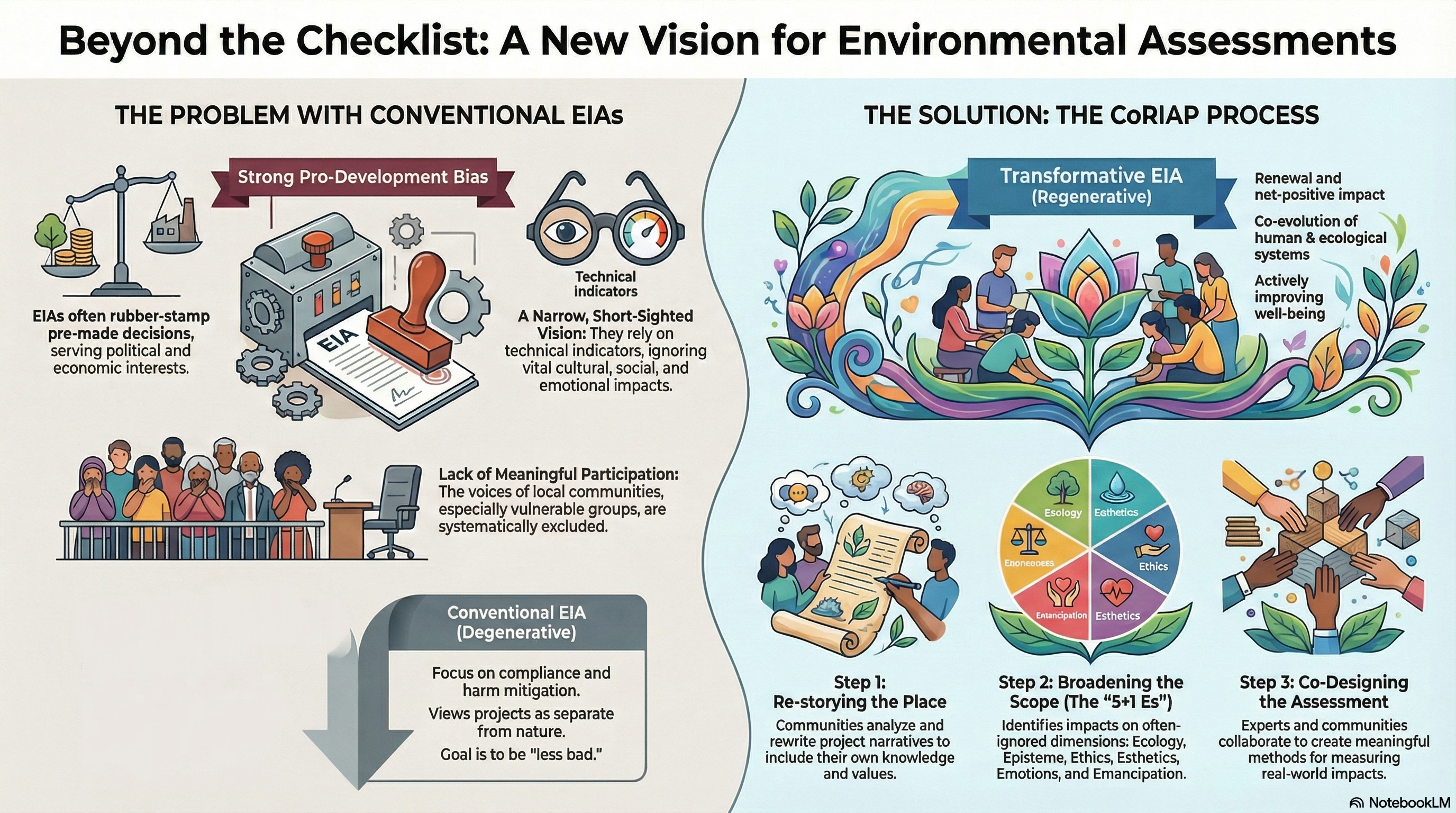
Large infrastructure projects pose substantial and frequently irreversible threats to biological and cultural diversity. These projects predominantly rely on one-size-fits-all solutions, informed by extractive paradigms that endanger the vitality of social-ecological systems. This tendency towards monotone solutions is epitomised by Environmental Impact Assessments (EIAs). In principle, EIAs should provide the opportunity for fair, accurate, and open-ended evaluation of projects; instead, they are often used instrumentally to facilitate the implementation of decisions already made elsewhere.
Building on debates on the integration of social and cultural aspects in EIA, our work seeks to address three core flaws found in conventional EIAs: (1) an inherent bias favoring development projects; (2) an anthropocentric, short-sighted vision of sustainability; and (3) a lack of meaningful participation by affected human communities. In this paper, we introduce the outcomes of a transdisciplinary retreat where academics, practitioners, and activists designed and tested a Co-Creative Relational Impact Assessment Process (CoRIAP), drawing on two archetypal cases in Kenya and Laos.
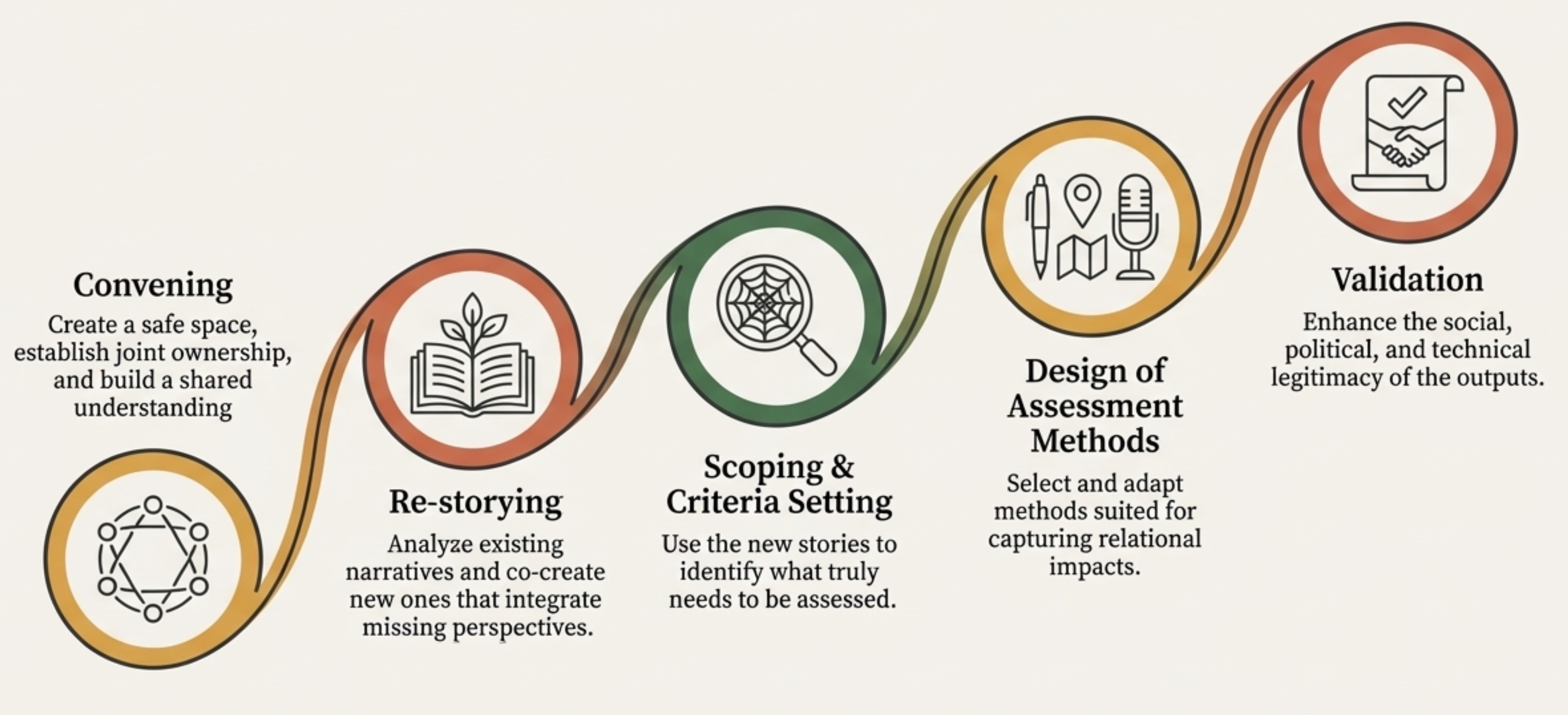
CoRIAP includes: (a) process-oriented components, aimed at transforming EIA from a routine checklist to a purposeful, inclusive, and open-ended procedure; and (b) measurement-oriented components, aimed at providing a framework for identifying relational criteria that are key to the well-being of humans and broader ecosystems, including ethics, emotions, aesthetics, and alternative ways of knowing. This novel protocol complements and broadens existing EIA practice, while providing communities with a tool for self-strengthening and reflection. On a higher level, our work contributes to refining the theoretical basis for integrating social and cultural elements into EIA practice.
FIVE STEPS for Transformative Impact Assessments
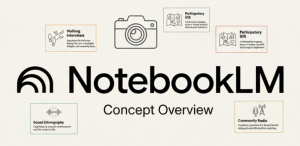
The following summaries of this peer-reviewed article may be helpful for sharing key findings with potentially interested audiences (auto-generated by NotebookLM) – including a slide deck, a concept overview, and a blog post:

To cite: D. Brombal, M. Foggin, K.R. Pearson, D. Del Bene, M. Cui, A. Moriggi, A. Razmkhah, A.L. Wainwright, C. Peterson, S. Kolipaka, A. Tritto, J. Owiti, and B. Okyere-Manu. (2026) Life beyond the checklist: Revitalizing the potential of environmental impact assessments through co-creation. Environmental Impact Assessment Review, Volume 118. https://doi.org/10.1016/j.eiar.2025.108219
The article is available to download free of charge here until 28 January 2026.